Module: Mission to Mars
Grade 3 · Lesson 1
Build an alien
that can stand.
Observe
- Video teaches shared language and tools.
- There is no prescribed design or right answer.
- Students brainstorm, prototype, test, and iterate.
What’s needed to run the lesson.
3 min
prep
Lay out the standard set of materials
50 min
class time
Press play
0
STEM expertise
Any staff member can run the lesson
One materials kit works across all 10 lessons for each grade.
No lesson-by-lesson kit assembly or supply hunt.
Want to run this lesson?
Students take on the challenge.
Educators see durable skills take shape.
Phase
Moment
Student voice
Educators notice
7 min
Open
Video-led
The hook
“We get to invent an alien!”
Curiosity and immediate engagement
The first idea
“What superpower should ours have?”
Voice, choice, and original thinking
The instruction
“Level Up, Level Up, Level Up”
Learning of shared language and tools
34 min
Build
The struggle
“It keeps falling over.”
Frustration, then investigation
The next attempt
“What could make it balance?”
Problem solving, perseverance, and iteration
9 min
Close
Video-led
The reflection
“Here’s how we got it to stand.”
Pride and ownership
The challenge creates the struggle.
The video teaches students how to work through it.
Designed by Stanford-trained educators
The challenge is just hard enough.
Every lesson is calibrated to the grade’s Zone of Proximal Development – difficult enough to require new thinking, but achievable with the right mindset, tools, and support.
Too easy
Little new thinking
Productive struggle
Stretch, support, and growth
Too frustrating
Students disengage
Every lesson intentionally teaches shared mindset and tools for working through the struggle.
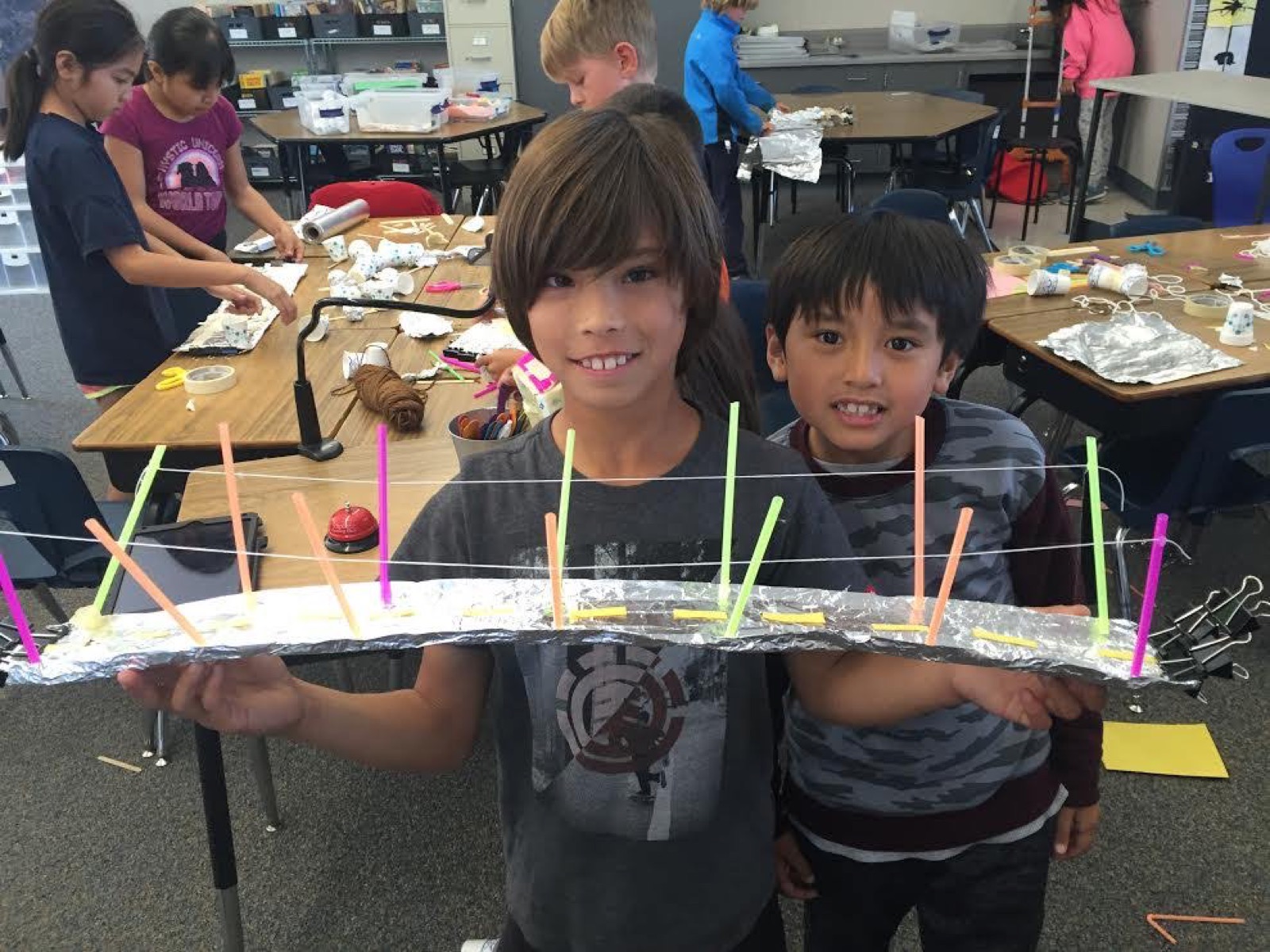
Videos
deliver the instruction.
- Teach STEM and durable skills
- Introduce the challenge
- Lead the design-thinking process
- Run cleanup and reflection
Teachers
connect with students.
- Notice who is stuck
- Draw out quieter voices
- Ask curious questions
- Help students work through frustration